Book of the Year
Those of you who have followed my ramblings over the years know that somewhere near the end of the year I note the best book I have read that year. And if you have followed my ramblings closely, you will know that my book of the year is seldom a book that was published that year. In fact, I think the only time that happened was in 2021, when a book commemorating Yuri Gagarin’s space flight, published 60 years after the fact, was my choice for book of the year. A handful of the books I read this year were actually published this year, but none made the cutoff for my coveted award.
Now the numbers. I read 25 books this year (not counting the three meditation books I read each year, one page per day). I have six books in progress, but with absolutely no chance of finishing any of them before the first of January. (Two are by the chemist Linus Pauling: I may not have those finished by this time next year. Sheesh!)
The first book I read this year was a tome by Peter Zeihan, entitled The End of the World is Just the Beginning. I read it because it was a free ebook from the Wall Street Journal. The WSJ subscription is ridiculously expensive, and I believe they gave these free ebooks (one per month) to help with the pain of paying the annual subscription. That did not work for me, and apparently it did not work for other subscribers, as they have stopped giving away these books. At any rate, the only reason I even mention this book is that I have to start this article somewhere. Don’t waste your time with this one.
I read a fair amount about local lore and my new/old home state of North Carolina. (I was born in the state, and lived here until almost my 26th birthday. I spent the next 44 years in other states: Maryland, Virginia, and Georgia. We have been back in the state for the last four years.) Three of the local lore books were Forgotten Tales of North Carolina (Tom Painter and Roger Kammerer), Spooky North Carolina and Spooky Great Smokies (both by S. E. Schlosser). These were light-hearted, fun reads. Two of the books took place primarily in my home county of Johnston, which for some unknown reason is now known as JoCo. See what happens to a place when you move away? These two books involved the moonshiner Percy Flowers. The first book I reviewed earlier, and I do not recommend it at all. The second book, Lost Flowers, by Perry D. Sullivan, was much better. If you have any interest in the life of that legendary moonshiner, you should read the Sullivan book.
Looking back at my list of books, I am shocked at the number of books I read on the topic of the War for Southern Independence and the Reconstruction Era that followed that war. As for the war, I can recommend The Civil War: A Narrative – Fort Sumter to Perryville, by Shelby Foote. This is the first of three volumes and it was clearly written by a novelist. I am working on the second volume at present. Honorable mention goes to Glory Road (Bruce Catton), A Southern View of the Invasion of the Southern States and War of 1861-1865 (Captain Samuel A’Court Ashe), War in the Mountains (J. L. Askew), and North Carolina as a Civil War Battleground: 1861 – 1865 (John Gilchrist Barrett).
As for Reconstruction, there is no finer work than a book by Claude Bowers, published some 50 years or so after the end of Reconstruction, entitled The Tragic Era: The Revolution After Lincoln. If you believe that Reconstruction was a net positive for the country, this book will change your mind. I nearly chose it as book of the year, even though it came out in 1930. Honorable mention goes to Reconstruction: Destroying a Republic and Creating an Empire, by James Ronald Kennedy.
Another book that deals very loosely with the War for Southern Independence and Reconstruction was actually published years before the war. A View of the Constitution of the United States of America (William Rawle) was a textbook used at West Point during Robert E. Lee’s days there. Rawle’s view is that secession is a right reserved to the States under our Constitution. Revisionist historians tend to overlook this detail. And recall that Rawle was writing at a time when some of the framers of the Constitution were still alive. Who has a better purchase on the truth: a contemporary of the framers, or a revisionist writing two centuries after the fact?
The rest of my reading is a hodge podge. I reviewed Triggernometry: A Gallery of Gunfighters (Eugene Cunnigham) earlier this year. It nearly became my book of the year. It is a swell read. Seven Wonders of the World (Lowell Thomas) was published in the mid-1950s, and has been sitting on my bookshelf since the late 1950s. I finally got around to reading it. I give it positive marks, but it is far from book of the year material. The Wrong Stuff: How the Soviet Space Program Crashed and Burned (John Strausbaugh) reinforced the opinion I had of the Soviet space program after reading the Gagarin book a few years ago. My wife suggested I read Orbital (Samantha Harvey) which was a novel about 24 hours on the International Space Station. No. No. No. Don’t bother. We agreed on that one.
Flashman: A Novel, by George MacDonald Fraser, was a good read, as was Shooter: The Autobiography of the Top-Ranked Marine Sniper, by Gunnery Sgt. Jack Coughlin and Capt. Casey Kuhlman, with Donald A Davis. Clearly ghost written, but entertaining. Another biography I enjoyed was Hollywood or Bust! By June Wilkinson. The word “bust” in that title definitely is a double entendre. Wilkinson was one of the most popular models in Playboy magazine during the ‘50s and ‘60s. I found the book entertaining, but I was saddened to learn that she died just a few weeks after I finished her book.
I am not happy with the Boy Scouts (or whatever they are called these days). I gave away my 1963 Boy Scout Handbook a few years ago, and replaced it with Deep-river Jim’s Wilderness Trail Book: Outdoor Life and Sports (written by Deep-river Jim, who I believe to be Clayton Holt Ernst). I recommend Of Boys and Men, by Richard V. Reeves. My personal opinion is that we are doing a poor job of encouraging boys to assume the manly virtues. You are welcomed to your own opinion. I also read The Politics of Prudence by Russell Kirk. I should try to read a book by the late Dr. Kirk every year. He was a sage.
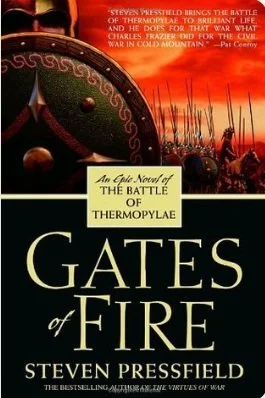
So, we have covered 24 of the 25 books. It is time for the book of the year, written in 1998 by Steven Pressfield. Who doesn’t enjoy a ripping good historical fiction, and what better event is there than the Battle of Thermopylae? I enjoyed Gates of Fire tremendously and heartily recommend it to you.
Happy reading in 2026!